
Rubella Test To Check Rubella Virus Infection and Antibodies
A Rubella test is a blood test that checks for antibodies to the rubella virus. It helps determine if you're immune to rubella or if you've had a recent infection.
Rubella Test
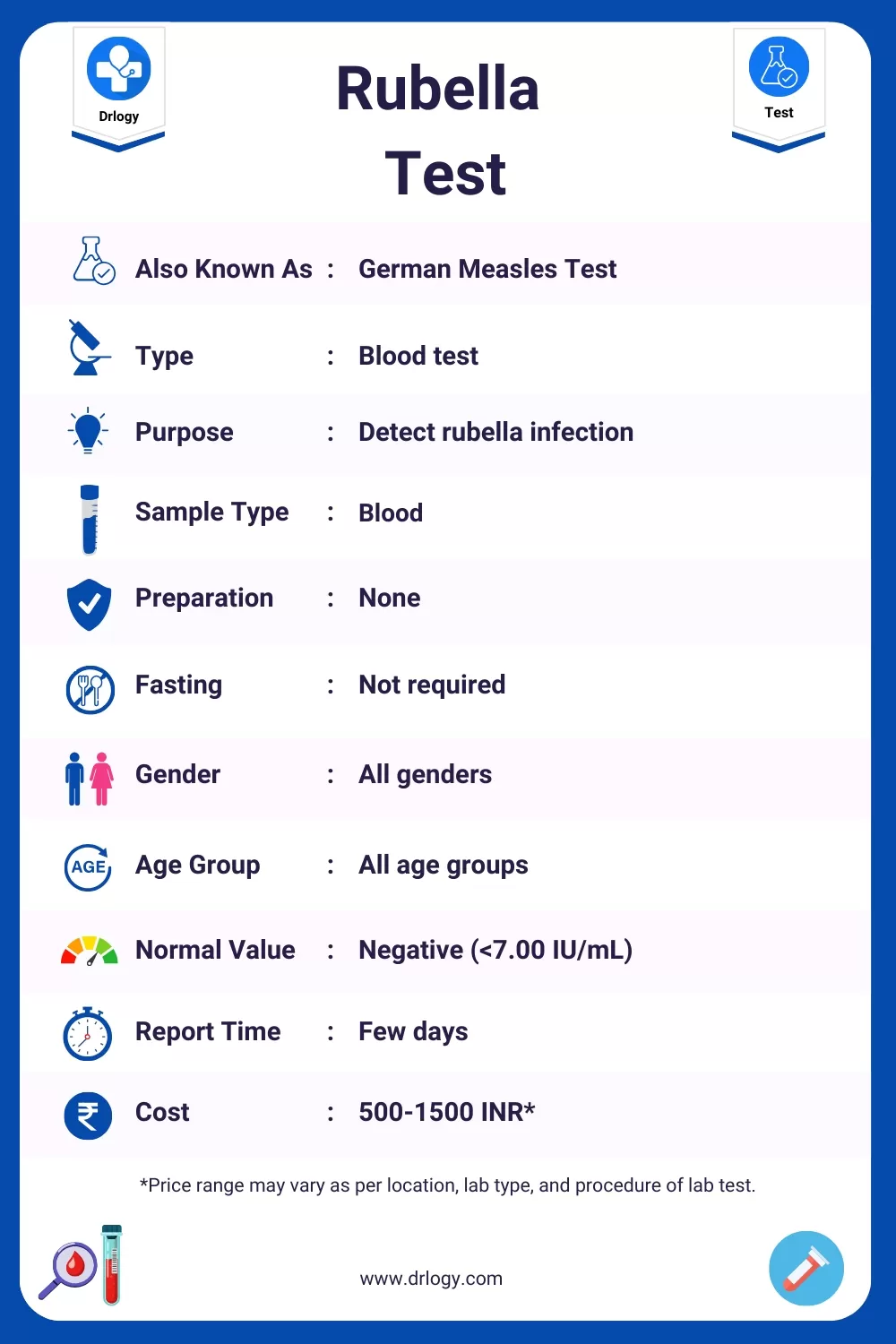
Here are the basic details of the Rubella Test.
| Also Known As | German Measles Test |
| Type | Blood test |
| Purpose | Detect rubella infection |
| Sample Type | Blood |
| Preparation | None |
| Fasting | Not required |
| Gender | All genders |
| Age Group | All age groups |
| Normal Value | Negative (<7.00 IU/mL) |
| Reporting Time | Few days |
| Cost | 500-1500 INR* |
*Price range may vary as per location, lab type, and procedure of lab test.
Rubella Test Means
The Rubella Test checks for evidence of the rubella virus, which causes German measles.
- It helps determine if a person is immune to rubella, either through vaccination or prior infection.
- This test is often part of prenatal screenings to protect pregnant individuals and their babies from rubella complications.
- It may be required to provide proof of immunity when traveling abroad, especially for healthcare workers and students.
- The Rubella Test typically involves a blood sample to detect antibodies, making it a non-invasive diagnostic tool.
Rubella Test Purpose
The purpose of the Rubella Test is to:
- Diagnose rubella infection
- Determine immunity or vaccination status
- Essential for prenatal screening during pregnancy
- Required for certain job, school, or travel-related proof of immunity
- Detect rubella exposure in symptomatic individuals
Rubella Test Preparation
Here is the basic preparation for the Rubella Test.
Before Test
- No special preparation is typically required.
- Inform your healthcare provider about any medications or conditions you have.
During Test
- A blood sample will be collected by a healthcare professional.
After Test
- There are no specific restrictions or aftercare instructions for most patients.
Rubella Test Procedure
Here is the basic Rubella Test Procedure.
- The rubella test typically involves drawing a blood sample from a vein in your arm.
- No specific preparation or fasting is usually required before the test.
- A healthcare professional will clean the area where the needle will be inserted with an antiseptic.
- A tourniquet may be applied above the area to help locate the vein for blood collection.
- A needle with a collection tube will be inserted to draw a blood sample.
- After the sample is collected, pressure will be applied to the puncture site, and a bandage will be used.
- The blood sample is then sent to a laboratory for testing to detect rubella antibodies.
- Test results are reported to your healthcare provider, who will discuss the findings with you.
Rubella Test Result
- Rubella test measures antibodies or genetic material of the rubella virus.
- Results are interpreted as detected (positive) or undetected (negative).
- A detected result suggests exposure or immunity, while undetected may indicate no current infection or immunity.
Rubella Test Normal Range
Here is the normal range of the Rubella Test
| Rubella Test Result | Normal Result |
|---|---|
| <7.00 IU/mL | Negative |
Rubella Test Interpretation
Here is the Interpretation of the Rubella Test.
| Rubella Test Result (IU/mL) | Interpretation |
|---|---|
| <7.00 | Negative |
| 7.00 to <10.00 | Equivocal |
| ≥10.00 | Positive |
Rubella Test Positive Results
A positive rubella test result indicates the presence of rubella-specific antibodies in the blood. Here are potential causes of a positive rubella test:
| Potential Causes | Description |
|---|---|
| Rubella Infection | The individual has had a recent or past rubella infection, leading to the presence of rubella-specific antibodies in the blood. |
| Rubella Vaccination | The individual has been vaccinated against rubella, resulting in the production of rubella-specific antibodies in response to the vaccine. |
| Recent Immune Response | Recent exposure to rubella or recent rubella vaccination can lead to a positive test, indicating an ongoing immune response and antibody production. |
A positive rubella test result typically suggests immunity to rubella either through vaccination or past infection. It's essential to consider the individual's medical history and vaccination status for accurate interpretation of the result.
Rubella Test Negative Results
A negative rubella test result indicates the absence of detectable rubella-specific antibodies in the blood. Here are potential causes of a negative rubella test:
| Potential Causes | Description |
|---|---|
| No Rubella Exposure | The individual has not been exposed to the rubella virus and has not received the rubella vaccine, resulting in the absence of rubella-specific antibodies. |
| Insufficient Time Since Exposure or Vaccination | If the test is conducted too soon after exposure to rubella or vaccination, there may not be enough time for the immune system to produce detectable antibodies, leading to a negative result. |
| Faded Immunity | In some cases, rubella antibodies may decline over time, especially in individuals previously immune through vaccination or natural infection, resulting in undetectable levels. |
| Immunodeficiency | Individuals with compromised immune systems may have difficulty producing antibodies, resulting in a negative rubella test even after exposure or vaccination. |
A negative rubella test result typically suggests a lack of immunity to rubella, necessitating further evaluation or consideration of vaccination to establish immunity and prevent infection.
Specimen Requirements For Rubella Test
Here are the specimen requirements for the Rubella Test.
| Specimen | Serum | |
| Volume | 0.5 ml | |
| Container | Red-top tube or gel-barrier tube | |
| Collection | Refrigerate. | |
| Storage | Refrigerate or freeze. | |
| Sample Stability | Temperature | Period |
| Room temperature | 2 day | |
| Refrigerated | 7 days | |
| Frozen | 7 days | |
| Freeze/thaw cycles | Stable x1 | |
| Causes for Rejection | Hemolysis; lipemia; gross bacterial contamination. | |
Rubella Test is Safe?
Rubella tests are safe and typically involve a blood sample.
- Minimal risks, such as minor bruising or discomfort during blood draw.
- The benefits of diagnosing or confirming rubella infection outweigh the minimal risks.
When Do You Get Rubella Test Results?
- Rubella test results are typically available within a few days.
- The exact turnaround time may vary depending on the laboratory and specific circumstances.
Rubella Test Limitation
Here is the basic limitation of Rubella Test.
- False negatives can occur in early infection.
- IgM antibodies may persist after a previous infection or vaccination.
- Timing is essential for accurate diagnosis.
Rubella Test Risk Factors
Here are some of the risk factors of the Rubella Test.
- Minimal risk; involves a standard blood draw.
- Possible minor discomfort or bruising at the needle site.
- No significant health risksectly related to the test.
Doctor Recommendations After Rubella Test Result
Here are the Doctor's recommendations or consult a specialist after the Rubella Test.
| Rubella Test Result | Doctor to Visit | Reason |
|---|---|---|
| Positive | Infectious Disease Specialist | Confirmed Rubella infection. |
| Negative | No specific doctor | Absence of Rubella infection. |
Rubella Test Price
Here are the estimated Rubella Test Prices in India with different top cities:
| City | Price Range (INR)* |
| 500-1500 | |
| 800-1500 | |
| 500-1500 | |
| 800-1500 | |
| 500-1500 | |
| 800-1500 | |
| 500-1500 | |
| 800-1500 | |
| 800-1500 | |
| 500-1500 | |
| 800-1500 | |
| 500-1500 | |
| 800-1500 | |
| 500-1500 |
*Prices are approximate and vary depending on a specific laboratory or healthcare facility.
Summary
Overall, Rubella Test is vital for confirming immunity, diagnosing infections, and ensuring effective vaccination strategies in the prevention of rubella outbreaks. Also check Drlogy Test for detailed information about all medical tests for patients, doctors, scholars and medical students.
Reference


