Drlogy
Healthcare organization
7 Test Result and Reference Range Tips For Pathology Report Format
Welcome to the fifth blog focusing on the Test Result and Reference Range section of pathology report format design. In pathology reports, test results and reference ranges serve as crucial indicators of a patient's health status, guiding clinical decisions and treatment strategies.
Recommended
Ensuring their accurate presentation and test result is essential for effective diagnosis and patient management. In this Drlogy Pathology Report Format, we'll explore crafting a comprehensive format for test results and reference ranges, crucial for accurate diagnosis and treatment decisions.
7 Key Things Should be Mentioned in Test Result and Reference Range for Pathology Report Format
Here are the 7 Key Things Should be Mentioned in Test Result and Reference Range for Pathology Report Format.
| Key Aspect | Description |
|---|---|
| Test Title | Name of the test being conducted. |
| Test Result | Numerical or qualitative outcome of the test. |
| Reference Range | Normal range of values for comparison. |
| Unit | Standard unit of measurement for the test result. |
| Abnormal Value Indication | Indication of whether the result is abnormal. |
| Methodology | Description of the methodology used for the test. |
| Interpretation | Explanation or clinical interpretation of results. |

Use the above format as a reference range.
1. Test Title:
- Clearly label each test being conducted.
- Use standardized terminology for consistency.
- Ensure accuracy in test titles for properentification.
- Avoid abbreviations or acronyms that may cause confusion.
- Verify test titles against established protocols.
Example
Test Name: C-REACTIVE PROTEIN (CRP) Test
2. Test Result:
- Present the numerical or qualitative outcome of the test.
- Use clear and conciseuage to describe the result.
- Include units of measurement for quantitative results.
- Double-check result accuracy before reporting.
- Ensure consistency in result presentation across reports.
Example
Result Ref Value 3.5 0.00 - 5.00 mg/dL Result: Normal Value
3. Reference Range:
- Provide the normal range of values for comparison.
- Include both upper and lower limits of the reference range.
- Specify the source of reference values if known.
- Highlight any deviations from standard reference ranges.
- Update reference ranges as needed based on current standards.
Example
Test Ref Value CRP Test 0.00 - 5.00 mg/dL
4. Unit:
- Specify the standard unit of measurement for the test result.
- Ensure clarity and consistency in unit representation.
- Use internationally recognized unit symbols or abbreviations.
- Confirm unit accuracy to prevent misinterpretation.
- Include units for both numerical values and qualitative descriptions.
Example
Test Ref Value Unit CRP 0.00 - 5.00 mg/dL
5. Abnormal Value Indication:
- Clearly indicate whether the result falls outside the reference range.
- Use symbols or annotations to highlight abnormal values.
- Provide clear annotations indicating "High" or "Low" for abnormal results.
- Include reference ranges for context in interpreting abnormal values.
- Ensure consistency in formatting to facilitate easyentification.
Example
Test Result Ref Value Unit CRP High 6.00 0.00 - 5.00 mg/dL
6. Methodology:
- Describe the methodology used to perform the test.
- Provide sufficient detail to understand the testing process.
- Include information on equipment, reagents, and techniques utilized.
- Verify the validity and reliability of the chosen methodology.
- Cross-reference methodology with established standards or protocols.
Example
Test Methodology: Immunoturbidimetry
7. Interpretation:
- Offer an explanation or clinical interpretation of the test results.
- Provide insights into the clinical significance of the findings.
- Consider the patient's medical history and presenting symptoms.
- Ensure interpretations are evidence-based and supported by literature.
- Use clearuage to communicate complex medical concepts.
Example
- Measurement of CRP is useful for the detection and evaluation of infection, tissue injury, inflammatory disorders, and associated diseases.
- High sensitivity CRP (hsCRP) measurements may be used as an independent risk marker for theentification of individuals at risk for future cardiovascular disease.
- Increase in CRP values are non-Specific and should not be interpreted without a complete history.
Top 10eal Pathology Report Format Examples For Result
Here are the Top 10eal Pathology Report Format Examples For Results.
| Test Name | Report Format |
| CRP Test | View PDF |
| RAST Test | View PDF |
| Dengue Test | View PDF |
| KFT Test | View PDF |
| Urine Culture Test | View PDF |
| HDL Cholesterol Test | View PDF |
| LDL Cholesterol Test | View PDF |
| VLDL Cholesterol Test | View PDF |
| C Peptide Test | View PDF |
| Dengue IgM Test | View PDF |
10 Mistakes Avoided For Test Result and Reference Range Section in Pathology Report Format
Here are 10 Mistakes Avoided For Test Result and Reference Range Section in Pathology Report Format.
- Misreporting test results or reference ranges.
- Omitting essential reference values.
- Providing inaccurate or outdated reference ranges.
- Failing to verify the validity of reference ranges.
- Using inconsistent formatting for test results.
- Misinterpreting or mislabeling test outcomes.
- Ignoring standard units of measurement.
- Neglecting to update reference ranges as needed.
- Excluding explanations of test methodologies.
- Disregarding the significance of abnormal results.
Dos vs Don't For Test Result and Reference Range in Pathology Report Format
Here are Dos vs Don'ts For Test Result and Reference Range in the Pathology Report Format.
| Do | Don't |
|---|---|
| Provide accurate test results. | Misinterpret or fabricate test outcomes. |
| Include clear reference ranges. | Omit reference ranges for test parameters. |
| Present results in an organized manner. | Mix up results or reference values. |
| Verify the validity of reference ranges. | Assume reference ranges without validation. |
| Update reference ranges as needed. | Neglect to update outdated reference values. |
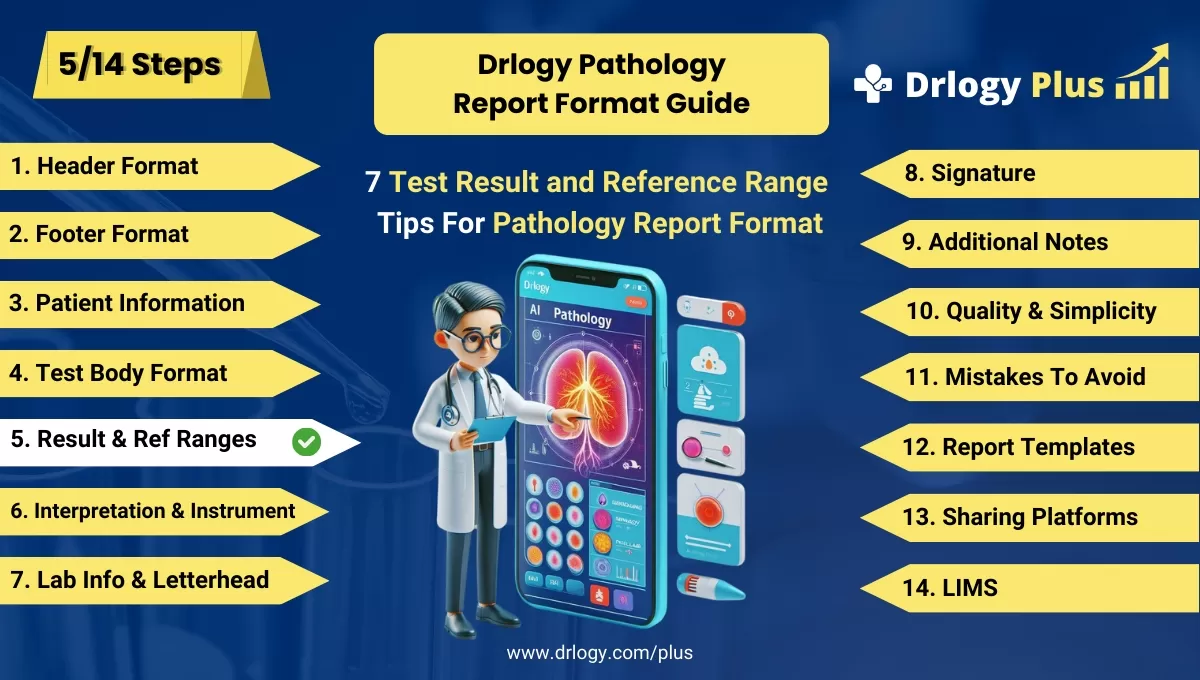
Pathology Report Format Guide
Here are 14 steps guide for designing a pathology lab report format from A to Z.
Summary
In conclusion, accurate presentation of test results and reference ranges is important for effective diagnosis and treatment decisions for pathology report format. Clear communication and adherence to standard reference values facilitate proper interpretation, ensuring optimal patient care and management.
Check Drlogy Pathology Report Format Guide For A to Z information regarding how to make proper report format structure to implementation of report format into you lab work.