Drlogy
Healthcare organization
5 Interpretation and Instruments Tips For Pathology Report Format
Welcome to the fifth blog focusing on the Test Interpretation and Instruments section of pathology report format design. In pathology reports, interpretation and instrumentation provide essential context to test results, aiding clinicians in understanding disease states and selecting appropriate treatments. Proper interpretation ensures accurate diagnosis and enhances patient care outcomes.
Recommended
In this Drlogy Pathology Report Format, we'll delve into the significance of interpretation and instrumentation, providing essential context to test findings for informed clinical decisions.
5 Key Things Should be Mentioned in Interpretation and Instruments For Pathology Report Format
Here are the 5 Key Things that Should be Mentioned in Interpretation and Instruments For Pathology Report Format.
| Key Aspect | Description |
|---|---|
| Interpretation | Clinical explanation or significance of the test results |
| Instruments Used | Description of the equipment or tools utilized |
| Methodology | Detailed explanation of the testing methodology |
| Clinical Context | Consideration of the patient's medical history and symptoms |
| Reference Sources | Sources consulted for interpretation and methodology |
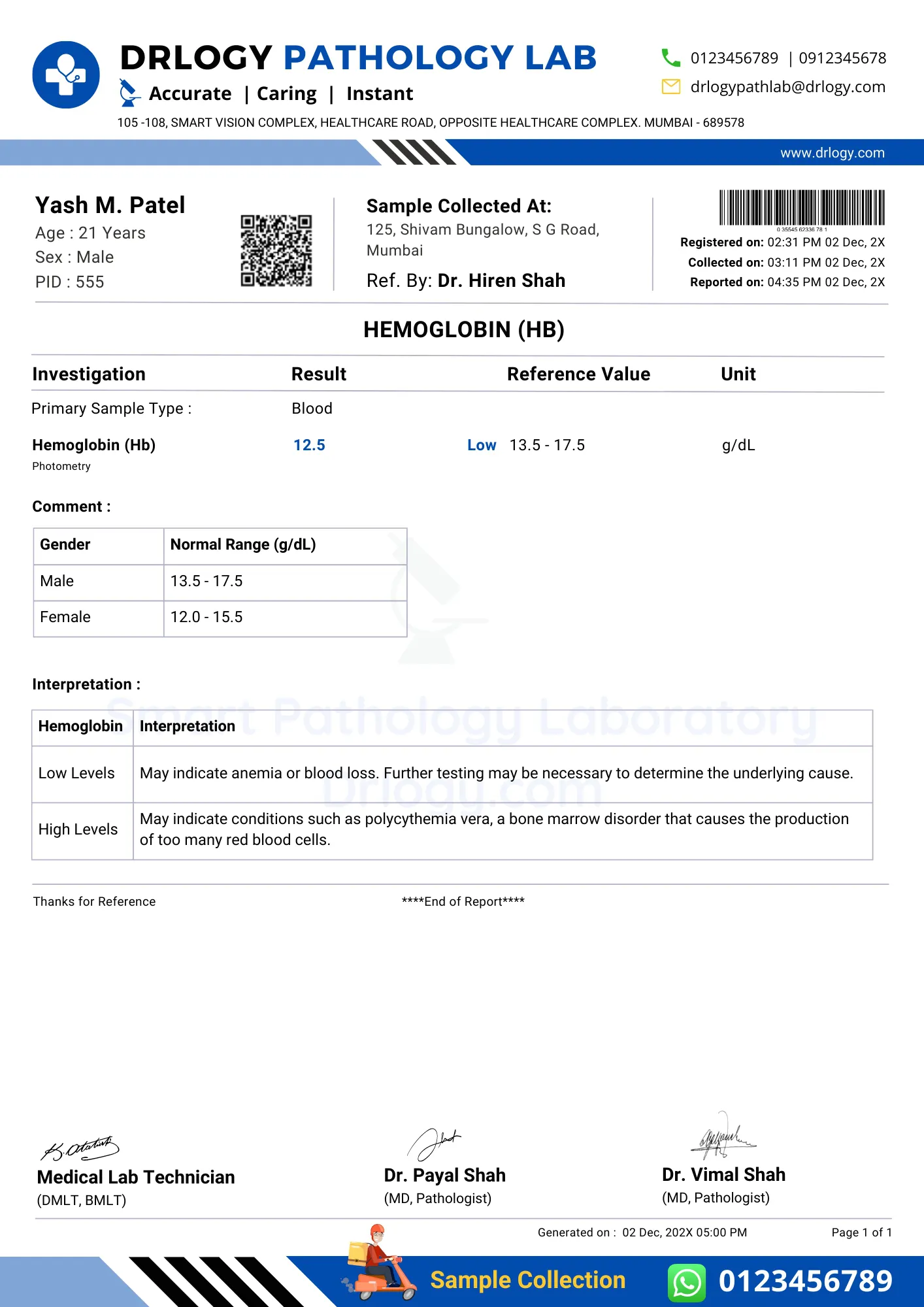
From above Hemoglobin Test Let's Find Out best way to write Interpretation for report format.
1. Interpretation:
- Provide a clinical explanation or significance of the test results.
- Offer insights into the implications of the findings for patient care.
- Consider the relevance of the results within the broader clinical context.
- Ensure interpretations are evidence-based and supported by literature.
- Use clear and conciseuage to communicate complex medical concepts.
Example
Hemoglobin Interpretation Low Levels May indicate anemia or blood loss. Further testing may be necessary to determine the underlying cause. High Levels May indicate conditions such as polycythemia vera, a bone marrow disorder that causes the production of too many red blood cells.
2. Instruments Used:
- Describe the equipment or tools utilized for conducting the tests.
- Specify the make and model of instruments, if applicable.
- Include information on any specialized instruments used.
- Ensure accuracy in describing the instrumentation for transparency.
- Mention any calibration or maintenance procedures followed.
Example
Instruments Used: Hematology Analyzer
3. Methodology:
- Explain the detailed process or methodology employed for the tests.
- Outline the steps involved in sample preparation and analysis.
- Describe any specific protocols or techniques utilized.
- Include information on reagents, controls, and validation procedures.
- Ensure clarity and completeness in detailing the methodology.
Example
Photometry
4. Clinical Context:
- Consider the patient's medical history, symptoms, and presenting condition.
- Assess how the test results fit into the overall clinical picture.
- Evaluate the relevance of the findings for diagnosis and treatment.
- Incorporate information from other diagnostic tests or procedures.
- Provide context for interpreting the results in light of the patient's condition.
Example
May indicate conditions such as polycythemia vera, a bone marrow disorder that causes the production of too many red blood cells.
5. Reference Sources:
- Cite relevant literature, guidelines, or protocols consulted for interpretation.
- Include references to established standards or recommendations.
- Ensure accuracy and credibility of the sources referenced.
- Provide access to additional resources for further reading if necessary.
- Acknowledge any limitations or uncertainties in the interpretation.
Example
Top 10eal Pathology Report Format Examples For Result
Here are the Top 10eal Pathology Report Format Examples For Results.
| Hemoglobin Blood Test | View PDF |
| Lipid Profile Test | View PDF |
| HbA1c Test | View PDF |
| PDW Blood Test | View PDF |
| Vitamin B12 Test | View PDF |
| ESR Test | View PDF |
| LFT Test | View PDF |
| RBS Test | View PDF |
| Ferritin Test | View PDF |
| FNAC Test | View PDF |
10 Mistakes Avoided For Interpretation and Instruments Section
Here are 10 Mistakes Avoided For Interpretation and Instruments Section in the Pathology Report Format.
- Providing improper or confused interpretations.
- Omitting explanations of instrumentation used.
- Using overly technicaluage without clarification.
- Inconsistencies in interpretation format.
- Failing to cross-reference interpretations with test results.
- Misinterpreting or misrepresenting test findings.
- Neglecting to update interpretations based on new evidence.
- Disregarding the importance of correlating interpretation with clinical context.
- Overlooking the significance of abnormal results.
- Ignoring standard guidelines for interpretation and instrumentation.
Dos vs Don't For Interpretation and Instruments Section
Here are Dos vs Don't For Interpretation and Instruments Section in Pathology Report Format.
| Do | Don't |
|---|---|
| Provide clear and concise interpretation. | Provide vague or ambiguous interpretations. |
| Include relevant details about test methods. | Omit explanations of instrumentation used. |
| Use standardized terminology for clarity. | Use jargon or technicaluage without explanation. |
| Ensure consistency in interpretation format. | Change interpretation format without justification. |
| Cross-reference interpretations with results. | Separate interpretation from relevant test findings. |
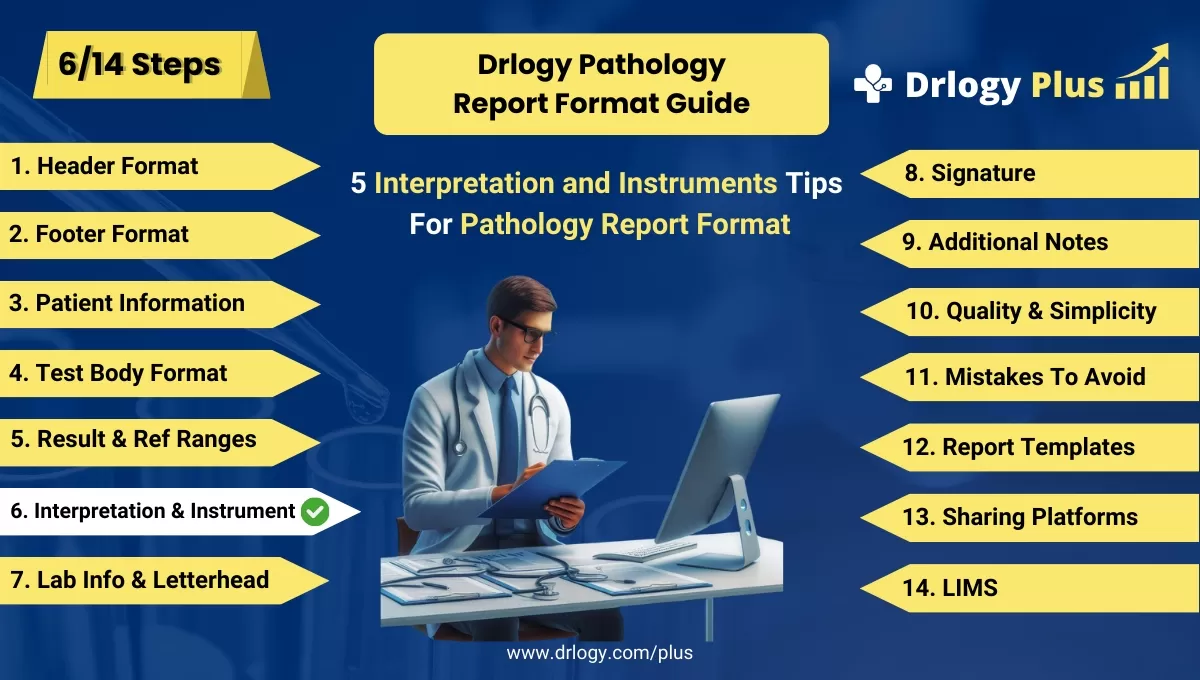
Pathology Report Format Guide
Here are 14 steps guide for designing a pathology lab report format from A to Z.
Summary
Overall, Interpretation and instrumentation section of pathology reports plays a pivotal in providing clinically relevant insights into test results, ensuring transparency in methodologies, and integrating findings within the broader clinical context, ultimately enhancing diagnostic accuracy and patient care outcomes.
Check Drlogy Pathology Report Format Guide For A to Z information regarding how to make proper report format structure to implementation of report format into you lab work.