Drlogy
Healthcare organization
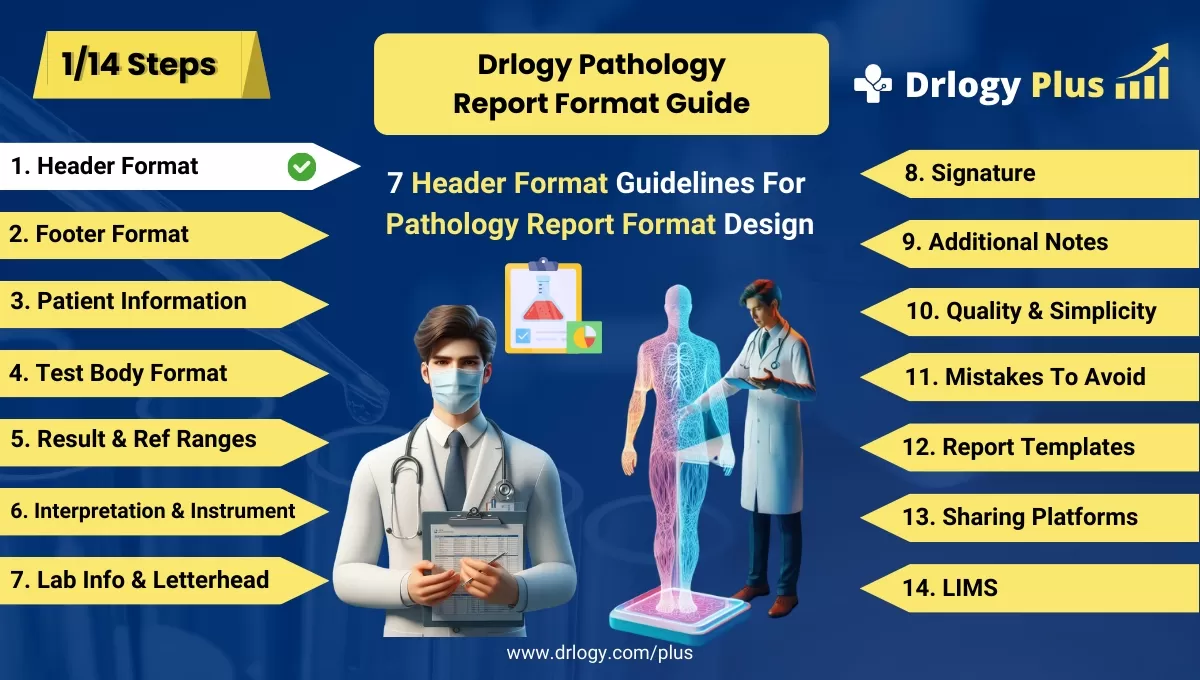
7 Header Format Guidelines For Pathology Report Format Design
Welcome to the first blog focusing on the header section of pathology report design, a pivotal component in conveying essential laboratory information efficiently and professionally.
Recommended
Crafting a clear and professional header for pathology reports is crucial for conveying essential lab information at a glance, ensuring ease of reference, and enhancing report credibility. In this Drlogy Pathology Report Format we'll learn how to create proper header format for your lab report format.
7 Key Things Should be Mentioned in Header for Pathology Report Format
Here are the 7 Key things should be mentioned in Header for best Pathology Report Format that helps pateint and doctor.
| Section | Description |
|---|---|
| Patient Info Section | Includes patient demographics. |
| QR Code or Barcode | Enhances report authenticity. |
| Sample Collection Info | Details of specimen collection. |
| Reference Doctor Details | Name and credentials of referring physician. |
| Registered Details (Time) | Time of report registration. |
| Collected Details (Time) | Time of specimen collection. |
| Reported Details (Time) | Time of report generation. |

1. Patient Info:
- Ensure accuracy of patient demographics to avoid misidentification.
- Include name, age, gender, and any uniqueentifiers.
- Verify patient information for completeness and consistency.
- Respect patient confidentiality and adhere to HIPAA guidelines.
- Collect relevant medical history or clinical information if available.
Ensure accurate patient demographics, including name, age, gender, and UHID.
2. QR Code or Barcode:
- Implement clean anr aatractive QR codes or barcodes for enhanced report authenticity.
- Utilize scanning technology to streamline report verification.
- Ensure compatibility with standard scanning devices.
- Include uniqueentifiers to link reports to specific patients and tests.
- Regularly update and maintain QR code or barcode databases for accuracy.
Following the COVID-19 pandemic, QR codes have become mandatory for pathology reports by goverments around the globe, making it essential for all lab owners to incorporate them to avoid legal repercussions.
3. Sample Collection Info:
- Document details of specimen collection accurately.
- Mention full address where sample was collected
- Clearly document the name and credentials of the individual responsible for collecting the sample.
- Include information about sample type, collection method, date/time and .
- Collaborate with healthcare providers to optimize sample collection protocols.
Precisely document specimen collection: include full address of collection site and collector's name with credentials.
4. Reference Doctor Details:
- Collect and document referring Doctor's name, Speciality and credentials.
- Establish clear channels of communication with referring physicians.
- Include contact information for referring doctors if available.
- Collaborate with referring physicians to ensure accurate and timely reporting.
- Maintain professionalism and confidentiality in all communications.
Must Mention referring Doctor's name & specialty.
5. Registered Details (Time):
- Record the time of report registration for tracking and auditing purposes.
- Ensure accurate timestamping of report registration to maintain data integrity.
- Use standardized time formats and time zones for consistency.
- Implement automated systems for efficient report registration.
- Regularly audit and review registered details for accuracy and completeness.
Accurate timestamping of report registration for tracking and auditing.
6. Collected Details (Time):
- Document the time of specimen collection accurately.
- Ensure proper documentation of collection time to track sample integrity.
- Use standardized time formats and time zones for consistency.
- Implement protocols to minimize delays in sample collection.
- Communicate collected details promptly to the laboratory for processing.
Accurately document specimen collection time for integrity tracking.
7. Reported Details (Time):
- Record the time of report generation for tracking and auditing purposes.
- Ensure accurate timestamping of report generation to maintain data integrity.
- Use standardized time formats and time zones for consistency.
- Implement efficient reporting systems to minimize turnaround time (TAT).
- Communicate reported details promptly to healthcare providers for patient management.
Document the date and time of report generation for accurate record-keeping and chronological tracking.
10 Mistakes That Must Avoid For Header Section in Pathology Report Format
Here are 10 Mistakes To Avoid For the Header Section in the Pathology Report Format.
- Misspelling or inaccurately representing the pateint or lab name.
- Failing to include essential contact information.
- Using inconsistent formatting or fonts.
- Neglecting to update the header with the current date or report version.
- Omitting important details such as patient names or uniqueentifiers.
- Overcrowding the header with excessive information.
- Not aligning the header properly within the report layout.
- Forgetting to include accreditation or certification logos.
- Using unprofessional or outdated design elements.
- Ignoring regulations regarding patient confidentiality or data security.
Dos vs Don't For Header Section in Pathology Report Format
Here are some Dos vs Don't For Header Section in Pathology Report Format design.
| Do | Don't |
|---|---|
| Include essential pateint information | Overcrowd with excessive details |
| Use clear and legible font | Use inconsistent or unreadable fonts |
| Ensure proper alignment | Neglect alignment or spacing |
| Include contact information | Omit important details |
| Update with current date/version | Forget to update regularly |
Pathology Report Format Guide
Here are the 14 Key Drlogy Pathology Report Format Guide thats every pathology lab must follow.
Summary
In conclusion, the header section of the pathology report serves as a vital gateway to essential information, encompassing patient demographics, sample details, and timestamps. Understanding its significance ensures accurate reporting, streamlined communication, and efficient patient care.
Check Drlogy Pathology Report Format Guide For A to Z information regarding how to make standard report format structure to implementation of report format into you pathology lab work.