Drlogy
Healthcare organization
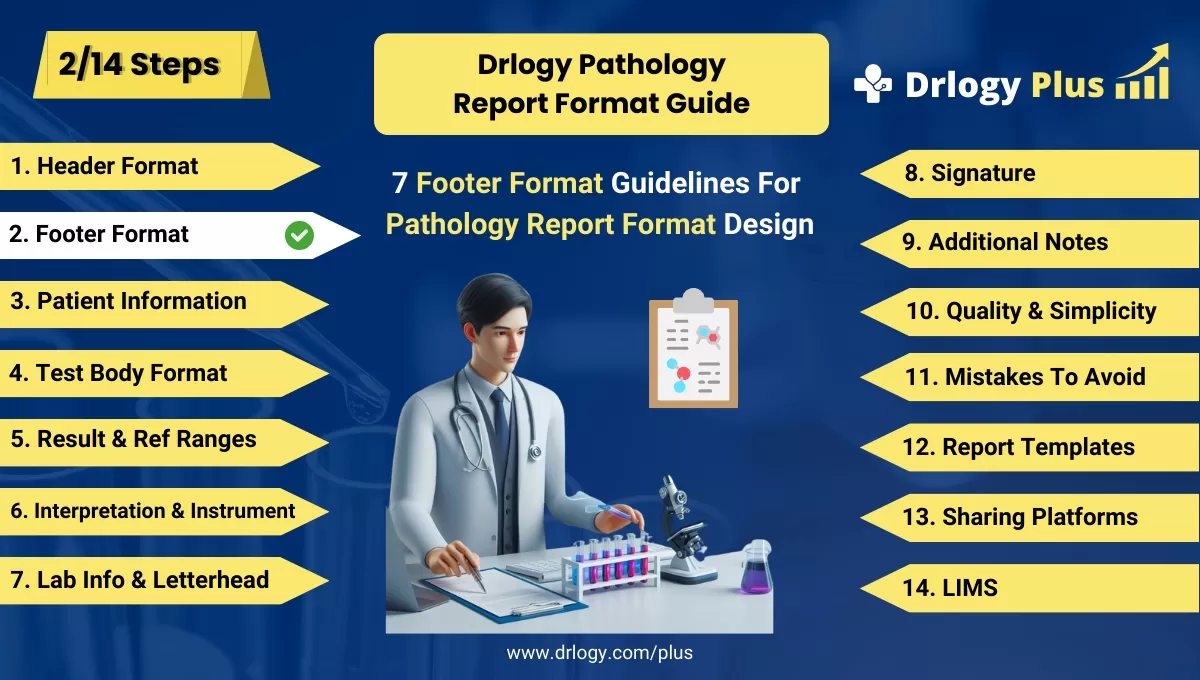
7 Footer Format Guidelines For Pathology Report Format Design
Welcome to our second blog focusing on the footer section of pathology report formats, highlighting its significance in ensuring report authenticity, organization, and communication efficiency within healthcare settings.
Recommended
In this Drlogy Pathology Report Format, we'll delve into the importance of a well-crafted footer, elucidating its in ensuring report authenticity, organization, and communication efficiency within healthcare settings.
7 Key Things Should be Mentioned in Footer for Pathology Report Format
Here are the 7 Key things should be mentioned in Footer for best Pathology Report Format that helps pateint and doctor.
| Section | Description |
|---|---|
| Signature | Authenticates report validity by specialist. |
| Report Generated Date and Time | Indicates when the report was generated. |
| Thanks Message For Reference | Optional gratitude to referring party. |
| Pagination | Provides organization for multi-page reports. |
| Printed By | Specifies who generated the report. |
| Lab Contact Details | Essential for further inquiries. |
| Key Services | List of key unique Services Provides. |

1. Signature:
- Ensure signatures of authorized personnel for report authentication.
- Maintain consistency in signature format and placement.
- Use electronic signatures if applicable and legally recognized.
- Include printed names and titles alongside signatures.
- Implement protocols for signature verification and authorization.
2. Report Generated Date and Time:
- Clearly indicate the date and time of report generation.
- Use standardized time formats and time zones for consistency.
- Ensure accuracy in timestamping for record-keeping purposes.
- Update the date and time with each report generation.
- Facilitate easy reference to the report's timeliness.
3. Thanks Message For Reference:
- Express gratitude to referring parties for their collaboration.
- Keep the message concise and professional.
- Customize the message based on the recipient and context.
- Ensure alignment with the lab's branding and communication.
- Include contact information for further assistance if needed.
4. Pagination:
- Number pages sequentially for organization and reference.
- Ensure consistent placement of pagination across reports.
- Facilitate easy navigation through multi-page reports.
- Include total page count for completeness.
- Avoid overcrowding the footer with excessive pagination details.
5. Printed By:
- Specify who generated or printed the report.
- Include initials or name of the responsible individual or department.
- Ensure accuracy in attribution to maintain accountability.
- Provide contact information for inquiries or assistance.
- Use consistent formatting for printed by attribution.
6. Lab Contact Details:
- Include essential contact information for the laboratory.
- Provide phone numbers, email addresses, and physical addresses.
- Ensure accuracy and consistency in contact details.
- Facilitate easy communication for inquiries or follow-up.
- Consider including additional contact options such as fax numbers or website URLs.
7. Key Services:
- Include key unique services that offer by laboratory.
- Highlight each service by unique way so that patient and doctorentify.
- Unique key services like 24 X 7, Home Collection, E Report facility, etc.
- Provide phone numbers, email addresses, and physical addresses.
- Use visually distinct icons or symbols to represent each key service for quick recognition.
- Briefly describe each unique service in a concise manner to provide clarity to patients and doctors.
10 Mistakes That Must Avoid For Footer Section in Pathology Report Format
Here are 10 Mistakes To Avoid For the Footer Section in the Pathology Report Format.
- Neglecting to include essential contact information.
- Overcrowding the footer with excessive details.
- Using inconsistent formatting or fonts.
- Forgetting to update footer information regularly.
- Omitting important details such as pagination or report generation date.
- Misaligning footer elements within the report layout.
- Failing to include a thank-you message or acknowledgment.
- Using unprofessional or outdated design elements.
- Not providing clear attribution for report generation.
- Ignoring regulations regarding patient confidentiality or data security.
Dos vs Don't For Footer Section in Pathology Report Format
Here are some Dos vs Don't For Footer Section in Pathology Report Format design.
| Do | Don't |
|---|---|
| Include essential contact info | Overcrowd with excessive details |
| Keep formatting consistent | Use inconsistent fonts |
| Update information regularly | Neglect to update footer information |
| Ensure clear attribution | Omit important details |
| Provide thank-you message | Misalign footer elements |
Pathology Report Format Guide
Here are 14 steps guide for designing a pathology lab report format form A to Z.
Summary
In conclusion, the footer section of the pathology report format plays a crucial in providing authentication, organization, and accessibility to the report. It ensures professionalism, accountability, and ease of communication, essential for effective healthcare coordination and patient care.
Check Drlogy Pathology Report Format Guide For A to Z information regarding how to make proper report format structure to implementation of report format into you lab work.